Here's a sentence you won't hear from any coaching billboard in Varanasi:
You don't need JEE to work at TCS.
You need a recognised computer-applications degree, a working knowledge of one programming language, the patience to clear an aptitude round, and the willingness to relocate to Hyderabad or Pune for your first 18 months. That's roughly the entire formula. The BCA (Bachelor of Computer Applications) was designed for exactly this funnel — and the IT services industry has been hiring through it for 25+ years.
This is the post we'd write to a 12th-pass student who thinks "computer engineering" only happens via B.Tech.
What BCA actually is
BCA is a 3-year undergraduate degree in computer applications, regulated by your state university (in our case, MGKVP — Mahatma Gandhi Kashi Vidyapith, a UGC-recognised state university under Sections 2(f) and 12(B)). The full name "Bachelor of Computer Applications" gives away the focus: applications of computing, not the deep electronics of B.Tech CSE.
Practically, BCA teaches:
- Two or three programming languages (typically C, C++ or Java, and Python)
- Data structures, algorithms, DBMS (SQL + relational design)
- Web stack basics (HTML/CSS/JS, plus one backend framework)
- Operating systems, computer networks, software engineering fundamentals
- One specialisation in your final year (BITE offers an AI/ML track)
What it deliberately skips compared to B.Tech: the physics-heavy electronics, advanced mathematics like vector calculus, and four full semesters of "core engineering" that most software jobs never touch.
That trade is the whole point. You spend three years instead of four. You take one university-level entrance instead of two (no JEE). And you graduate eligible for almost the same entry-level IT services jobs.
The TCS / Infosys / Wipro hiring reality
The "Big 3" Indian IT services hire ~150,000 fresh graduates a year between them. The eligibility line for their bulk hiring (TCS NQT, Infosys HackWithInfy, Wipro Elite NTH) reads roughly:
Any 3- or 4-year UG degree in Computer Applications, IT, or Computer Science, with 60% throughout academics, with backlog conditions, with the willingness to take our online test.
BCA passes that filter. Every year.
And here's the underrated part: TCS doesn't care whether your degree says BCA or B.Tech CSE on the salary day. The starting salary for their NQT cohort is the same number — around ₹3.5 LPA for the Ninja tier, ₹7+ LPA for Digital. The difference is your B.Tech roommate spent ~₹6 lakh on tuition and you spent a fraction of that.
What BCA at BITE actually involves
BITE has 60 sanctioned seats for BCA per batch, MGKVP-affiliated, 3 years across 6 semesters. The infrastructure:
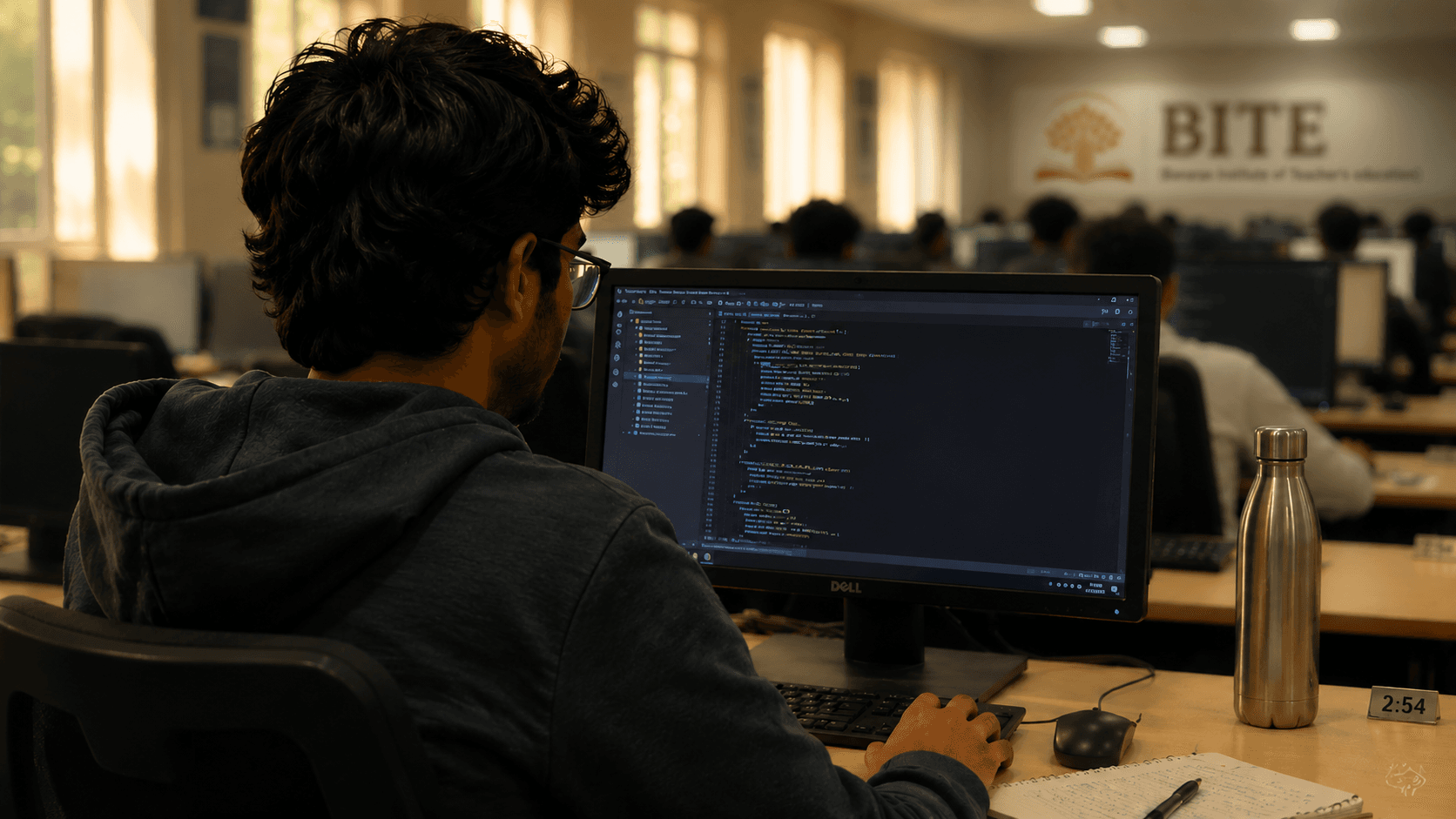
- 120-system computer lab — 2:1 student-to-system ratio, which is genuinely rare for a Tier-2 city BCA
- AI/ML elective in the final year, taught by faculty with industry exposure
- Capstone project — every Semester 6 student ships a real project (web app, mobile app, or ML model) defended in front of an external examiner
- Placement preparation integrated from Semester 4 onward — aptitude classes, coding rounds, mock interviews
The full programme details and module breakdown are on the BCA programme page.
The Semester-by-Semester reality
Semester 1-2: Foundations. Programming logic (in C), basic mathematics, communicative English. The first three months will feel slow if you've already done some coding in school; the rest of your batch is catching up.
Semester 3-4: The middle gear. Data structures, DBMS, OOP with Java, web technologies. By the end of Semester 4 every student has built at least one full-stack mini-project.
Semester 5-6: Specialisation + capstone. You choose AI/ML or applied web/mobile. The capstone is six months of one project that you defend in your final viva. Most students put this on their first resume.
The university exams happen in May–June and November–December. There are no surprise mid-semester tests that didn't appear in the calendar.
"Will I get a placement?"
The honest answer: placement is a function of you, not the college. No college in India can promise a placement without an asterisk attached.
What BITE can promise:
1. A 120-system lab open from 8am to 8pm — including the evening hours when you actually want to code without a class disruption 2. Aptitude and coding-round preparation integrated into the syllabus from Semester 4 3. Industry-relevant electives that match the skills hiring panels are testing for, refreshed annually 4. A dedicated placement cell that brings campus-level recruiters and trains for off-campus drives
What you have to bring:
1. One small project on GitHub before the start of Semester 5. Not a tutorial-along — a real thing you built because you wanted to. 2. One language you know cold. Not three half-languages. One. 3. 300 LeetCode-equivalent problems by end of Semester 5. The aptitude+coding rounds at IT services have a predictable shape; preparation is the only variable.
If you do those three things and use the lab time available to you, you will get a placement. We've watched it happen for 20+ batches.
When BCA is a bad fit
We owe you the converse honestly:
- If you want to do core hardware, embedded systems, VLSI, robotics — BCA isn't your degree. B.Tech ECE or CSE is.
- If your career endgame is a highly mathematical specialisation (quant finance, theoretical CS research) — BCA can get you there but it's a longer path; an undergrad in mathematics + a specialised master's might be cleaner.
- If you want to work in foreign markets via H1B/Tier-1 — possible from BCA but harder than from a BTech CS; you'll likely route via a US master's first.
For 90%+ of students who want a recognised computing degree that opens IT-services hiring and lets you pivot into product companies after 2-3 years of experience: BCA is a structurally sound choice.
Apply, visit, or just see the lab
The MGKVP undergraduate counselling for BCA runs through the central university process. BITE applications for 2026-27 are open through July 2026.
- Programme page → — full module breakdown, fee structure, faculty
- Apply Online → — 8-minute form
- Visit the lab → — walk in any working day, 10am–5pm, ask for the BCA coordinator
The 120-system room is the easiest way to know if BITE is right for you. Most students decide in the first 10 minutes inside it.
— Abhishek Mishra
Was this article helpful?