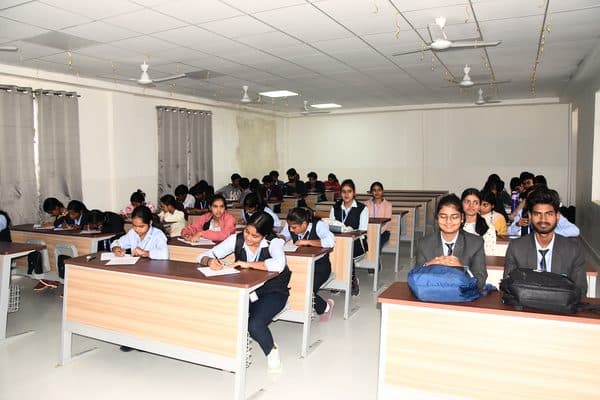
B.Ed at BITE is the programme we are known for. NCTE-recognised since 2003, MGKVP-affiliated, and designed to produce teachers who can walk into a Uttar Pradesh government or private school on day one and actually teach. This is a practical guide to what the programme contains and how B.Ed admission actually works — with one thing to know up front: the 2026-27 seats are already filled, so read the admission section as the route for the next cycle.
The basics
- Duration: 2 years (4 semesters)
- Affiliation: Mahatma Gandhi Kashi Vidyapith (MGKVP)
- Recognition: NCTE file UP-850 · MGKVP college code 134 (the affiliation code, not an NCTE identifier)
- Mode: Regular, classroom-based (no distance variant)
- Intake: 100 seats
- Fees: See the fee structure page for current cycle
Eligibility
Applicants need a bachelor's degree in any discipline (BA / B.Sc. / B.Com / BBA / BCA / equivalent) with a minimum of 50% aggregate from a UGC-recognised university. Reserved-category students get the standard 5% relaxation. Lateral entry is not available — this is a fresh 2-year track.
What you actually learn
The B.Ed syllabus at BITE follows the NCTE two-year framework, structured across four semesters:
Year 1 (Theory + foundations):
- Philosophical and sociological foundations of education
- Psychology of learning and development
- Contemporary India and education policy
- Language across the curriculum (bilingual pedagogy for UP classrooms)
- Introduction to pedagogical subjects (you pick two — usually aligned with your UG degree)
Year 2 (Pedagogy + practicum):
- Advanced pedagogy for two selected subjects
- Assessment, evaluation, and action research
- Inclusive education (disability-sensitive teaching)
- School internship — 120+ days in partner schools across Varanasi and adjoining districts
The school internship is the single most formative component. Trainees plan lessons, deliver them under faculty observation, handle real classroom discipline, and get graded on both lesson design and classroom execution.
CTET / UPTET preparation
The practical point of a B.Ed for most candidates is to qualify for a teaching job. That means clearing CTET (central) or UPTET (Uttar Pradesh state) within a year or two of graduating. BITE integrates CTET-relevant content directly into the B.Ed syllabus — child development and pedagogy questions on CTET overlap significantly with Year 1 coursework. A dedicated optional coaching module in the final semester covers the question patterns for both exams.
Historical pass rates: BITE's B.Ed cohorts have maintained ~78% CTET pass rate (2024 cohort) and ~92% B.Ed. exam pass rate (2025 cohort). Numbers vary by year and cohort size.
Career pathways
After B.Ed, the common paths are: 1. Government teaching — Primary and upper-primary teacher recruitment via UP Basic Education Board, UPPSC, KVS, NVS (Kendriya Vidyalaya / Navodaya Vidyalaya). CTET / UPTET is a prerequisite. 2. Private-school teaching — CBSE / ICSE schools in tier-1 and tier-2 cities; BITE's placement cell facilitates campus visits from 40+ partner schools. 3. Higher studies — M.Ed, M.A. (Education), Ph.D. for college-level teaching careers. 4. Education-adjacent roles — EdTech curriculum design, educational content writing, training roles in corporate L&D. 5. Competitive exams — UPSC prelims often include education-policy questions; several UPSC aspirants use B.Ed as a second option.
How B.Ed admission actually works
B.Ed admission in Uttar Pradesh runs through the state entrance exam, not through a college application form. The route is:
1. Appear for UP B.Ed JEE — register for and sit the state joint entrance examination. This is the step that decides everything downstream; miss the registration window and you miss the year, because the exam runs once annually. 2. Choose BITE in state counselling — with your JEE rank card, select BITE Varanasi (MGKVP college code 134) in your preference list. Seats are allotted by JEE rank. 3. Complete admission at campus — document verification and fee payment once a seat is allotted to you.
BITE conducts no college-level test of its own: selection is by UP B.Ed JEE rank, and the 100 sanctioned seats (plus a 10% EWS quota) are filled through state counselling. Reservation policy follows the UP state norm. Our admission cell walks candidates through the counselling forms free of charge — call before a choice-filling round closes, not after.
Common questions
Is MGKVP B.Ed accepted for CBSE school recruitment? Yes. MGKVP is UGC-recognised (Section 2(f) + 12(B)), and NCTE is the qualifying body for B.Ed. CBSE schools accept NCTE-recognised B.Ed degrees from any university — including MGKVP.
Can I do B.Ed after a distance-mode bachelor's degree? It depends. NCTE requires a UGC-recognised bachelor's; many distance-mode programmes from open universities qualify, but it's worth checking with our admissions office at enquiry@bitevns.ac.in before applying.
What if I haven't decided on my pedagogy subjects yet? That's fine. The selection happens at the end of your first semester, giving you three months on campus to discuss with faculty mentors and understand what suits your strengths.
When to apply
All B.Ed seats for 2026-27 — the 100 sanctioned places plus the 10% EWS quota — have been allotted, so there is nothing left to apply for on this programme this cycle. B.Ed enquiries are being taken for the next cycle — register your interest on the admissions page and the admissions cell will contact you when UP B.Ed JEE counselling opens. The elementary-teacher route is not an alternative this session either: D.El.Ed 2026-27 admissions closed — enquiries open for 2027-28. B.P.Ed is still admitting for 2026-27 until 30 September 2026.
Was this article helpful?